Hello Readers and Friends!
Ending a rehabilitation program does not have to close the conversation about recovery.
That is the message I take from the American Heart Association and American Stroke Association’s updated rehabilitation guidance—and it matters to anyone wondering what comes next after stroke.
After a stroke, there may come a time when progress seems to stop. You may hear the word “plateau.” It can sound as though you have reached the limit of what you will ever be able to do. That can be hard to hear. But a period of little progress does not automatically tell us what the rest of someone’s life will look like.
After my massive stroke in 2005, rebuilding my life became a long-term undertaking. My experience with aphasia and recovery shaped my memoir, Relentless, and continues to shape my writing and speaking. I know personally why the possibility of further progress matters. I also know that my experience is one person’s story, not a prediction for someone else.
Ending a rehabilitation program does not have to close the conversation about recovery.
What the guidance says
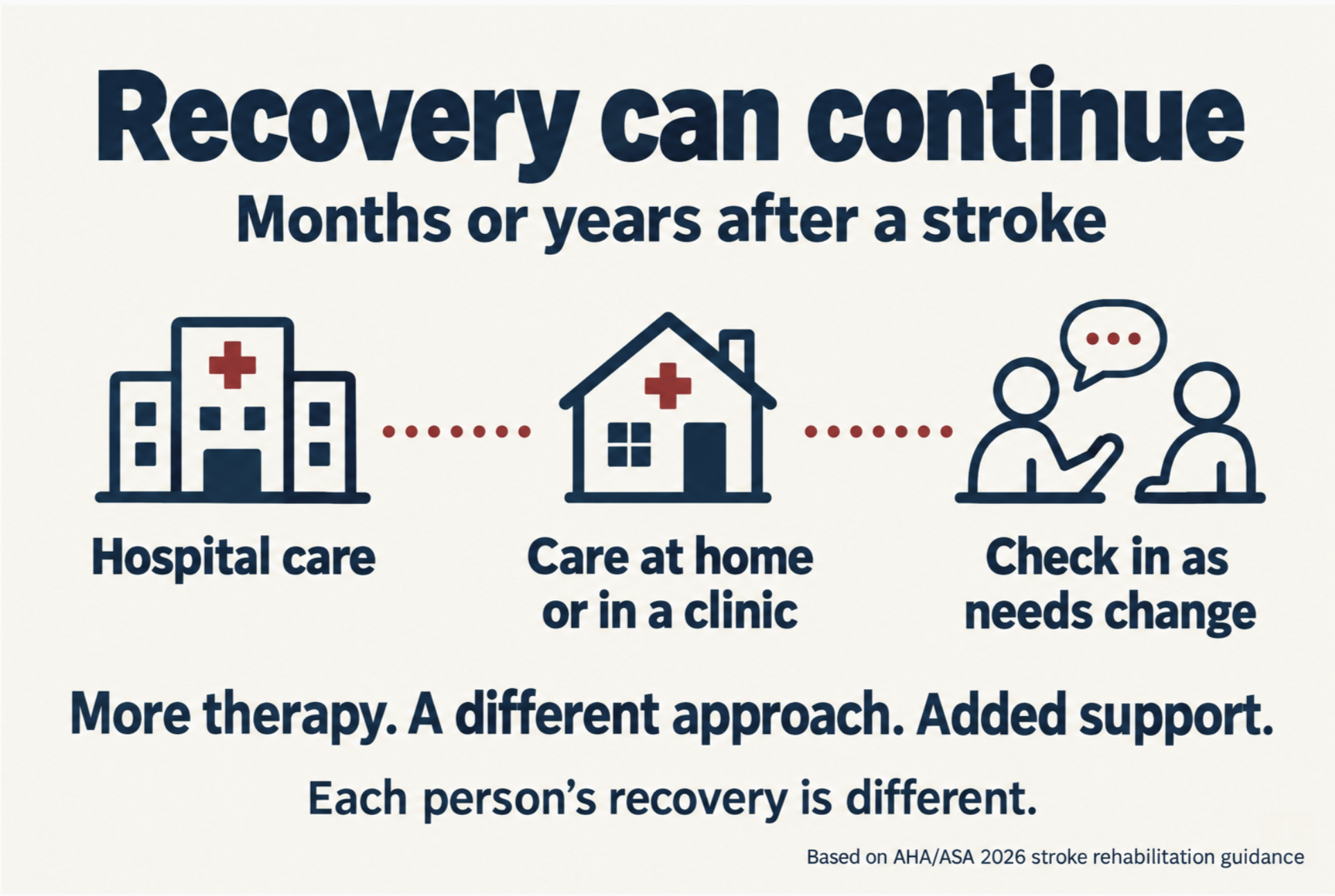
The 2026 Guideline for Adult Stroke Rehabilitation and Recovery, published August 27 offers a sound basis for hope without promising an outcome. The Association describes recovery over months to years, with no clearly defined endpoint. It also stresses how widely outcomes vary. Some people regain independence; others continue to need substantial support.
The guidance encourages checking in with a care team again after rehabilitation ends. A care team can help decide whether more therapy could help. These conversations may lead to a new goal, a different way to practice, or more support.
Progress in Everyday Life
Recovery can mean regaining an ability or learning a different way to do something. Both can make daily activities easier.
For someone living with aphasia, which affects language, a meaningful goal might be joining a family conversation more easily. Taking part in meaningful activities is a worthwhile goal, even when some difficulties remain.That could mean practicing speech, using pictures, or allowing more time to communicate.
Taking part in meaningful activities is a worthwhile goal, even when some difficulties remain.
What My Stroke Has Taught Me
After my massive stroke in 2005, rebuilding my life took years. Living with aphasia has helped me understand how much communication, independence, and a sense of purpose matter.
That is why the guidance about checking in with a care team again matters to me. A slow period can be a reason to ask what might help next. Recovery can also mean finding a different way to take part in everyday life.
My experience gives me hope about long-term recovery. But my story cannot predict someone else’s outcome. A survivor whose progress looks different from mine has not failed.
My experience gives me hope about long-term recovery.
Questions For A Care Team
If progress has slowed or regular appointments have ended, these questions may help guide a conversation:
-
- Would another assessment help us decide what to work on now?
- Could more therapy or a different approach help with something I want to do?
- What can I safely practice at home, and how will we know if it helps?
- When should we review my plan again?
Additional resource: American Stroke Association stroke rehabilitation information

The Journey Continues
Life continues to challenge me in new ways every day. One of the reasons I wrote Relentless: How A Massive Stroke Changed My Life for the Better was to give other survivors and their caregivers the inspiration to keep fighting forward. I am beginning to better understand how essential the caregiver’s persistence and drive matters on the journey to recovery. I hope my story provides a much needed reminder that there is still hope ahead.
Get your copy at any of the following retailers:





I’m sure you join me in wishing Senator Chris Murphy the best as he recovers from his recent stroke. It reminds me of the journey we all face. But it’s not just about rehabilitation.